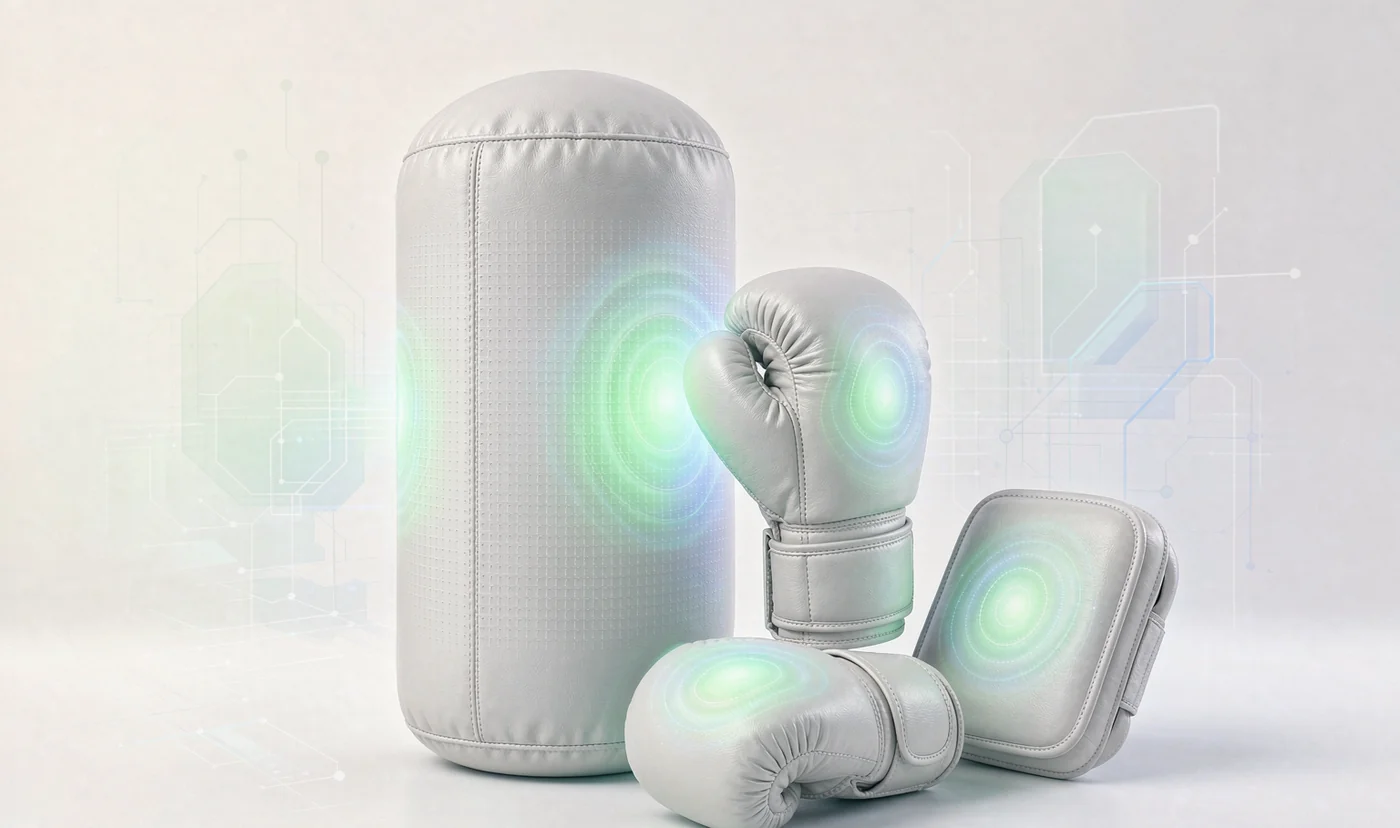
Sports sensing has four distinctive demands: high force, large area, frequent impacts — and it must not interfere with movement. All four play to piezoelectric film's strengths and to rigid sensors' weaknesses.
Deployment scenario
Under a punch-test target, a film array outputs impact force split by position and magnitude. Taekwondo chest and shin guards embed sensing zones to score valid strikes. Running-shoe insoles map plantar pressure for gait analysis and injury prevention. Training machines (rowing ergs, strength racks) integrate film at grips and footplates to record the peak and rhythm of every effort.
Achievable performance
Film turns an entire panel into a force-sensitive array rather than placing sensors at a few points — which is exactly what determines the spatial resolution of strike detection. Being flexible and bendable, it conforms to curved protective gear and is practically imperceptible to the athlete.
One caveat: piezoelectric output is proportional to the rate of change of force, not the force itself, so absolute peak impact force requires integrating the charge signal and calibrating at system level — and that calibration must be done in the actual assembled state. Laboratory values from a bare film cannot be carried over.
Comparison of technical routes
| Aspect | PVDF film array | Piezoresistive mat | Force plate / load cell |
|---|---|---|---|
| Form fit | Bendable, conforms to gear | Soft but baseline drift | Rigid, floor-mounted only |
| Sensing area | Scalable to large arrays | Expensive at scale | Fixed size |
| Dynamic response | Fast, suited to impacts | Slower, with hysteresis | Fast and accurate |
| Cost | Low, mass-producible | Moderate | High |
| Limitations | Needs calibration for absolute values; static force decays | Drifts after fatigue | Not wearable; ground reaction only |