Tipsense focuses on PVDF piezoelectric film sensors — design, production and system development for flexible sensing devices and systems on human, equipment and robotic surfaces.
Headquartered in the Hefei Economic & Technological Development Area with a branch in Shanghai, the company covers material R&D, product design, hardware and software development, system development, manufacturing and technical services — delivering a complete chain from component to system.
Founded in July 2021, the company received first-round investment in 2022 from the HRG (Hefei) International Innovation Research Institute and the Hefei Seed Fund.
Core team members come from the Chinese Academy of Sciences, TE Connectivity and Texas Instruments. R&D staff account for 80% of the team, with long-term research partnerships at Fudan University and Hefei University of Technology. 25 patents filed, 13 granted.
PVDF piezoelectric film
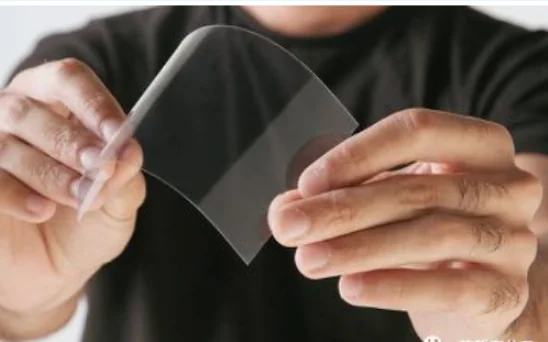
PVDF (polyvinylidene fluoride) piezoelectric film is a polymer piezoelectric material. Its poling process is complex and only a limited number of manufacturers worldwide can produce it at volume. The material is soft, light and tough, and can be formed into elements of any shape and thickness; combined with microelectronics it becomes a multifunctional sensing element.
Material characteristics
PVDF film combines dielectric, piezoelectric and pyroelectric effects. Compared with conventional piezoelectric materials it offers wider frequency response, larger dynamic range, higher electromechanical conversion sensitivity and more easily matched acoustic impedance — together with low weight, flexibility, impact resistance, resistance to water and chemical contamination, and free-form shaping. Applications span consumer electronics, automotive electronics, medical devices, instrumentation and industry.
Broadband vibration sensing
For broadband vibration sensing, PVDF is valuable not only for its frequency response, but also for its low mass, flexibility, low mass loading and fast dynamic response. The film can be bonded to or embedded in equipment housings, pipes, flexible structures and irregular surfaces, reducing the effect of a rigid sensor's added mass on the natural dynamics of the host structure. Its relatively low acoustic impedance also supports mechanical energy transfer across the sensing interface.
At lower frequencies, PVDF can capture structural imbalance, looseness, periodic motion and respiration-related dynamics. At higher frequencies, it can detect impacts, friction, leak acoustics, gear-meshing features and early bearing anomalies. The usable response depends on film thickness, electrode geometry, encapsulation, mounting interface, charge amplifier, filtering and sampling rate, and should be confirmed through application-specific frequency-response testing and system calibration.
From material to scenario
In health monitoring, the film is placed inside mattresses, cushions, sanitary fixtures and fall-detection mats, capturing vital-sign data continuously without skin contact. Compared with single-point sensors, film offers better signal consistency and is better suited to long-term analysis.
Signal processing extracts heart-rate anomalies, respiratory anomalies, deep/light sleep distribution, sleep habits and body-turn counts, forming health-management plans through the application layer. The sensing area layout can be adapted on demand, improving sensitivity while preserving stretchability.